Why ground edges on insulating glass?
The edge of an insulating glass unit sits in the frame and cannot be seen, so it is usually left as cut. But the edge is the weakest part of the glass: almost every break starts there. When the glass is partly in sun and partly in shade, a ground edge reduces the risk of it cracking.
A cut edge is sharp and full of tiny cracks
When glass is cut, the edge is left sharp, with wavy lines and small chips where the glass has been snapped. Most of these cracks cannot be seen with the naked eye.
Grinding takes off the sharp arrises and levels the edge. The glass is safer to handle and install, and the edge is stronger.
Edge types
Cut edge: unworked, sharp.
Arrised edge: the sharp arrises removed. The usual edge on toughened glass.
Ground edge: the edge levelled with a grinding wheel; it may stay shiny in places.
Smooth ground (matt): the whole edge evenly matt. For glass with a visible edge.
Polished: smooth ground, then polished to a shine. Where the look of the edge matters.
On insulating glass units the edge sits in the frame and is not visible, so an arrised or ground edge is enough. Smooth ground and polished edges are for edges that remain on show.
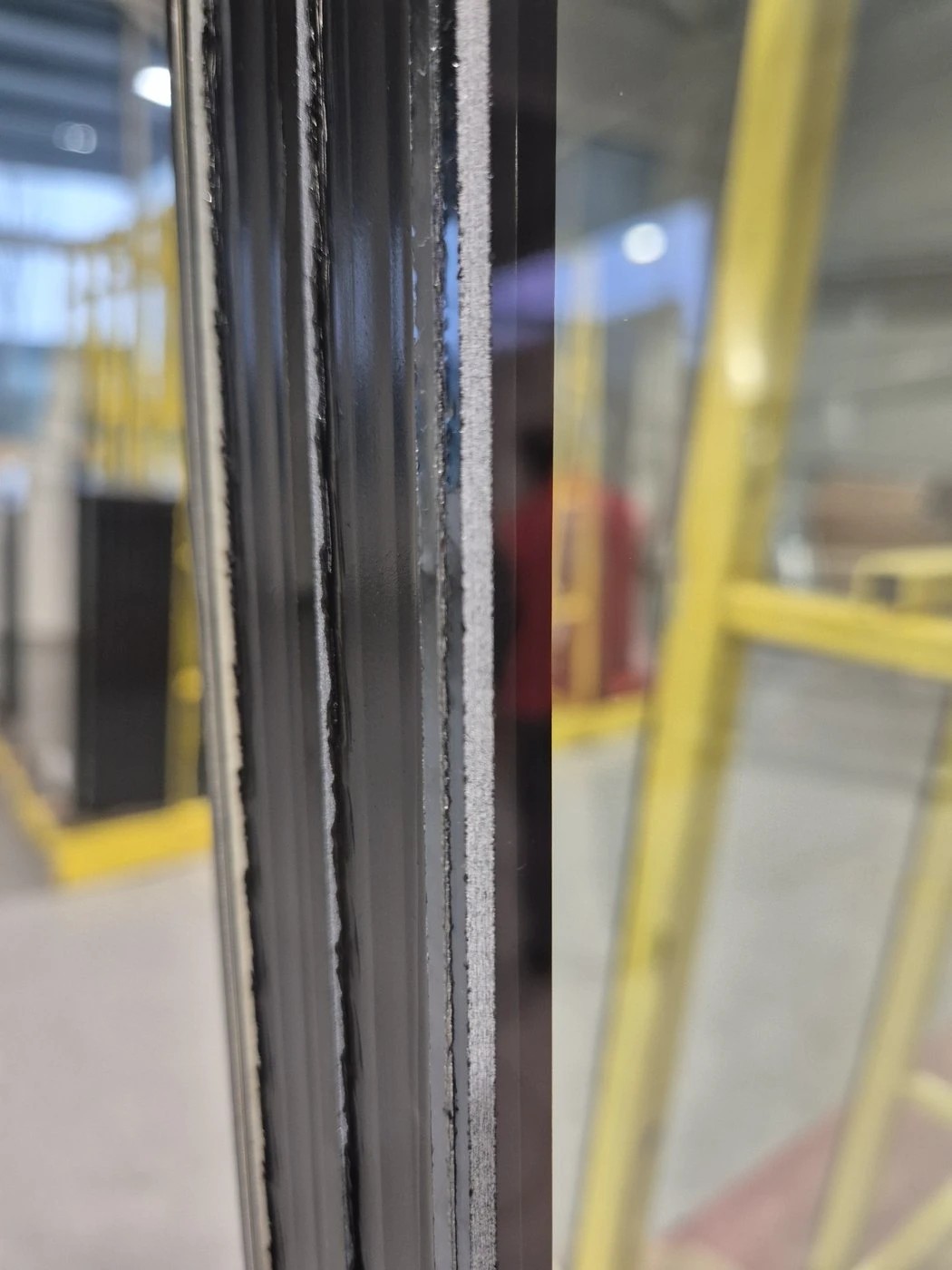
Thermal breakage always starts at the edge
When part of the pane is in the sun and part is in shade or inside the frame, the warm part expands and the cold part does not. The glass can take this up to a certain temperature difference, and then it cracks.
The crack always starts at the edge, at right angles to it. For the first 2 to 5 cm it runs straight, and then it branches.
How much the glass can withstand depends directly on the quality of the edge. Every tiny crack on the edge is a point where a break can start.
How much grinding helps
The maximum temperature difference across a single pane that the glass can take (French standard NF DTU 39):
Float and laminated, cut edge: 35 °C
Float and laminated, ground edge: 42 °C
Heat-strengthened: 150 °C
Toughened: 215 °C
A ground edge takes about 20% more temperature difference than a cut one. That helps, but it does not make the glass toughened. Where the temperature difference is large, the answer is toughened or heat-strengthened glass.
It does not crack straight away, but later
A poorly finished edge with near-invisible cracks, or an edge damaged in transit, does not crack on the day of installation. The glass breaks months or years later, the first time sun and shade create a large enough difference.
That is why we grind every pane that goes into our units.
Send us your opening schedule
or a project brief.
We reply with a quote and a technical data sheet, and on request a specification clause for your bill of quantities.